How Dean Cabinetry Integrated Acumatica and Salesforce
See how Dean Cabinetry worked with MindCloud to automate Acumatica and Salesforce, eliminating close to 2 hours of manual data entry a day and speeding up payment collection.
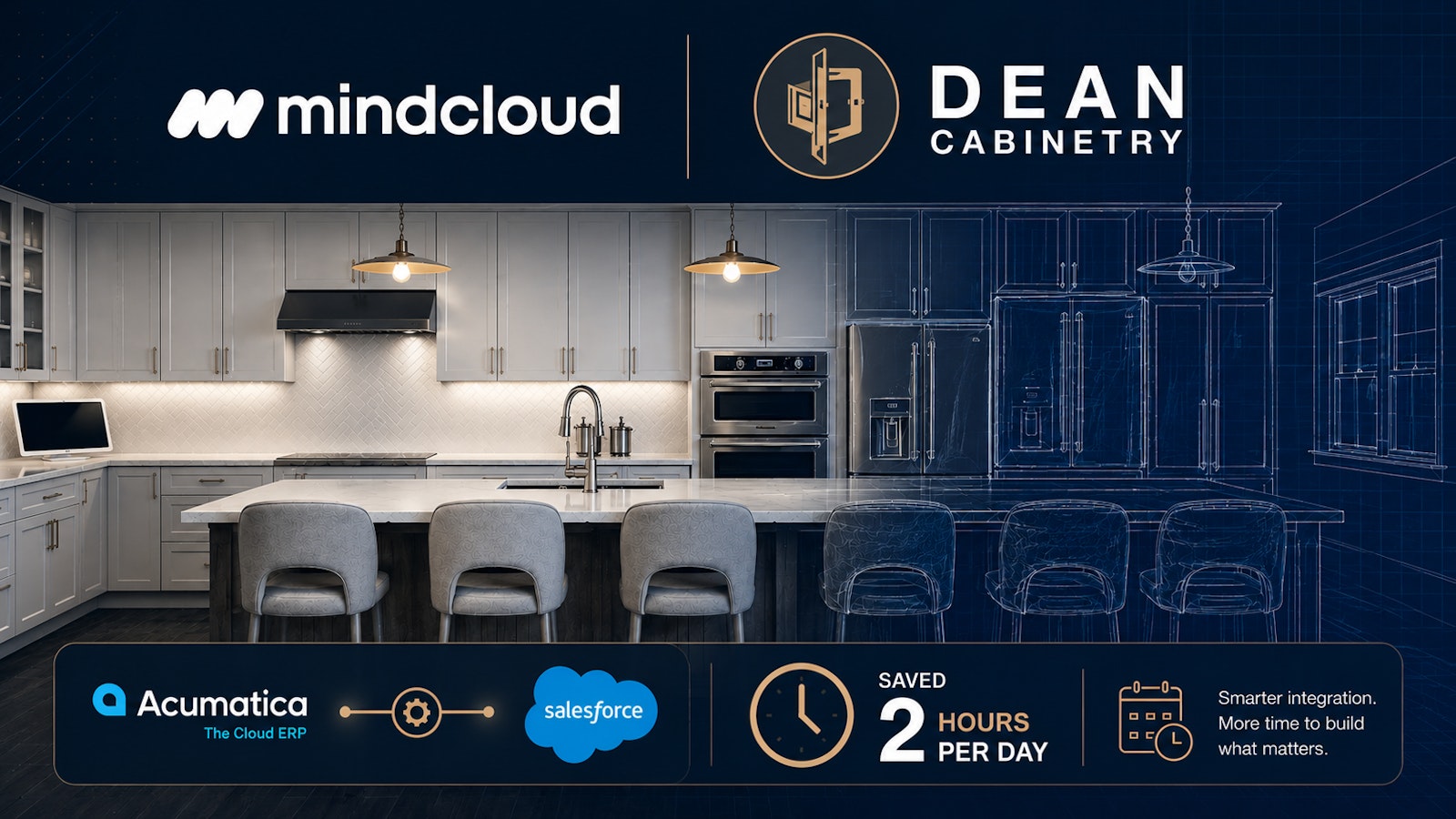
Dean Cabinetry designs and builds custom cabinetry, running sales through Salesforce and financials and operations through Acumatica.
As the business grew, one gap kept creating friction: Acumatica and Salesforce didn't talk to each other. Every new customer, every payment, and every sales order had to be typed in twice — once in each system, by hand.
Erica Dean wears several hats at Dean Cabinetry — she's the one who ends up doing this connective work, and the one who feels it most when it breaks down.
The Cost of Manually Bridging Two Systems
Dean Cabinetry runs on lean manufacturing principles. Every morning, the team reviews the "8 wastes" of lean — over-processing, interruptions, waiting time, and more. The manual work of connecting Acumatica and Salesforce hit nearly all of them.
"Every day I would get a notification when I needed to create a new customer in Acumatica, and I would be manually jumping back and forth between the systems to connect the two and manually enter data, which is just archaic."
— Erica Dean, Project Manager, Dean Cabinetry
This happened 5 to 6 times a day. Each instance took a few minutes, but every one was an interruption — a context switch away from whatever Erica was actually working on. And when she fell behind, the ripple effect showed up immediately: client managers waiting on a new customer record, unable to move a deal forward, would start asking why it wasn't done yet.
The pain was concentrated on one person, and on everyone waiting behind her.
What is manual data entry costing your team?
Take the free 5-minute assessment to get your integration health score, an estimated annual cost of integration issues, and personalized recommendations—delivered to your inbox.
Evaluating the Options
Dean Cabinetry looked at a handful of ways to solve the problem before finding MindCloud, including Celigo, MuleSoft, and Commerciant. Modern automation tools like n8n and Zapier weren't an option at all — they don't support Acumatica.
Celigo came closest, but it came with a catch: the team would need to configure and manage the integration themselves.
"The white glove service [is why we chose MindCloud], because with Celigo we'd have to configure everything ourselves and manage it, and I just don't have the bandwidth."
— Erica Dean, Project Manager, Dean Cabinetry
For a lean team already stretched across multiple roles, owning an integration platform wasn't realistic. MindCloud's fully managed model — where MindCloud's team builds, monitors, and maintains the connection — was the deciding factor.
From Kickoff to Go-Live in 12 Weeks
The implementation moved in a straightforward, iterative rhythm: define requirements, work through a round of clarifying questions, then start building.
Kickoff call: February 16
Requirements submitted: February 23
Go-live: May 13
Total time: approximately 12 weeks
What stood out to Erica wasn't just the outcome — it was the pace of communication along the way.
"During our implementation, everyone was very responsive. We were usually back and forth with emails 2 to 3 times a day, which sometimes it's like you send an email, 2 days and then a response, and that just slows everything down. So the responsiveness is key for us."
— Erica Dean, Project Manager, Dean Cabinetry
What MindCloud Built
MindCloud connected Acumatica and Salesforce with automated, two-way workflows, including:
Payment links and payment sync (Acumatica → Salesforce) — generated automatically instead of manually requested and relayed
Customer creation from opportunities (Salesforce → Acumatica) — new customers flow into Acumatica the moment a deal reaches the right stage
Sales orders, products, and line items (Salesforce → Acumatica) — created and updated without anyone re-keying data between systems
The result is that the manual "bridge" Erica used to operate by hand now runs on its own.
The Impact: Time, Speed, and Peace of Mind
The most direct change is time. Dean Cabinetry now saves roughly 20 minutes per connection, across 5 to 6 connections a day — close to 2 hours of manual data entry eliminated daily.
"It's hard to quantify time saved across the board, but per each connection we probably save 20 minutes — and some frustration. I don't even have to pay attention to it anymore, it just happens, which is great."
The effect goes beyond hours saved. Because payment links now generate automatically as soon as a deal closes, client managers get paid faster and know exactly where things stand — without chasing status updates.
"We get payment faster because before, client managers would wait on me to do the manual connection, then get the info back and send out the payment link. Now it's just automatic, so they have that payment link ready — they can send it out to a client for a quicker turnaround. They know their metrics now instead of always asking, 'did I get a close?'"
No headcount changes were required to support this volume — the impact was concentrated on reclaiming Erica's time and attention rather than adding staff.
"It's definitely a weight lifted for me."
— Erica Dean, Project Manager, Dean Cabinetry
See where your team could reclaim time.
Get a personalized view of the manual work, reliability risks, and integration costs in your own business.
Working With MindCloud
Asked to describe the experience of working with the MindCloud team from first conversation through ongoing support, Erica didn't hesitate:
"They've been great — responsive and friendly and clear. Good emails."
Asked for one word to summarize it:
"Supported."
And for anyone considering MindCloud for their own Acumatica integration:
"Working with MindCloud has been a relationship where I can place a lot of trust and not worry so much — I trust that it's happening and I don't need to spend my own energy on it."
— Erica Dean, Project Manager, Dean Cabinetry
Watch the Case Study
What Is Manual Data Entry Costing Your Team?
Dean Cabinetry's experience reflects a common pattern: teams don't need to become integration experts, they need their systems to simply work together — reliably, and without someone manually holding the two ends together every day.
MindCloud builds and fully manages Acumatica integrations with Salesforce, HubSpot, Shopify, and dozens of other platforms, so your team can focus on the business instead of the busywork between systems.
Take the free 5-minute assessment to get your integration health score, an estimated annual cost of integration issues, and personalized recommendations—delivered to your inbox.
Prefer to speak with someone? Talk to an integration specialist.