B2B Integration Services: What They Are and How They Work
B2B integration services are when a team provides that connection as a service, instead of the company building it itself.
What B2B integration services are
B2B means business to business: one company working with another, rather than with a consumer. B2B integration is connecting a company's systems to its trading partners' systems, so orders, invoices, shipping notices, and other business documents can move between companies without manual retyping.
B2B integration services are when a team provides that connection as a service, instead of the company building it itself. The service team scopes the work, builds the connections, tests them with each partner, and runs them after launch.
This is different from buying integration software and building it yourself. With software alone, your team does the building and the ongoing maintenance. With a service, the service team does that work, and your team describes the outcome it needs.
What kinds of connections this covers
B2B integration usually covers one or more of these:
EDI (Electronic Data Interchange). Structured documents exchanged with partners, such as purchase orders (850), shipping notices (856), and invoices (810). Many large buyers and retailers require EDI, and each partner has its own requirements for format and testing.
API (Application Programming Interface) connections. A direct, programmatic connection between two systems, often used when a partner offers an API for orders, stock, or status updates.
File-based exchange. Documents or data files sent on a schedule, for example a daily order file, where a direct API or EDI connection is not available.
Partner onboarding. Setting up a new trading partner: agreeing the document types, formats, and testing steps, then building and testing that partner's connection.
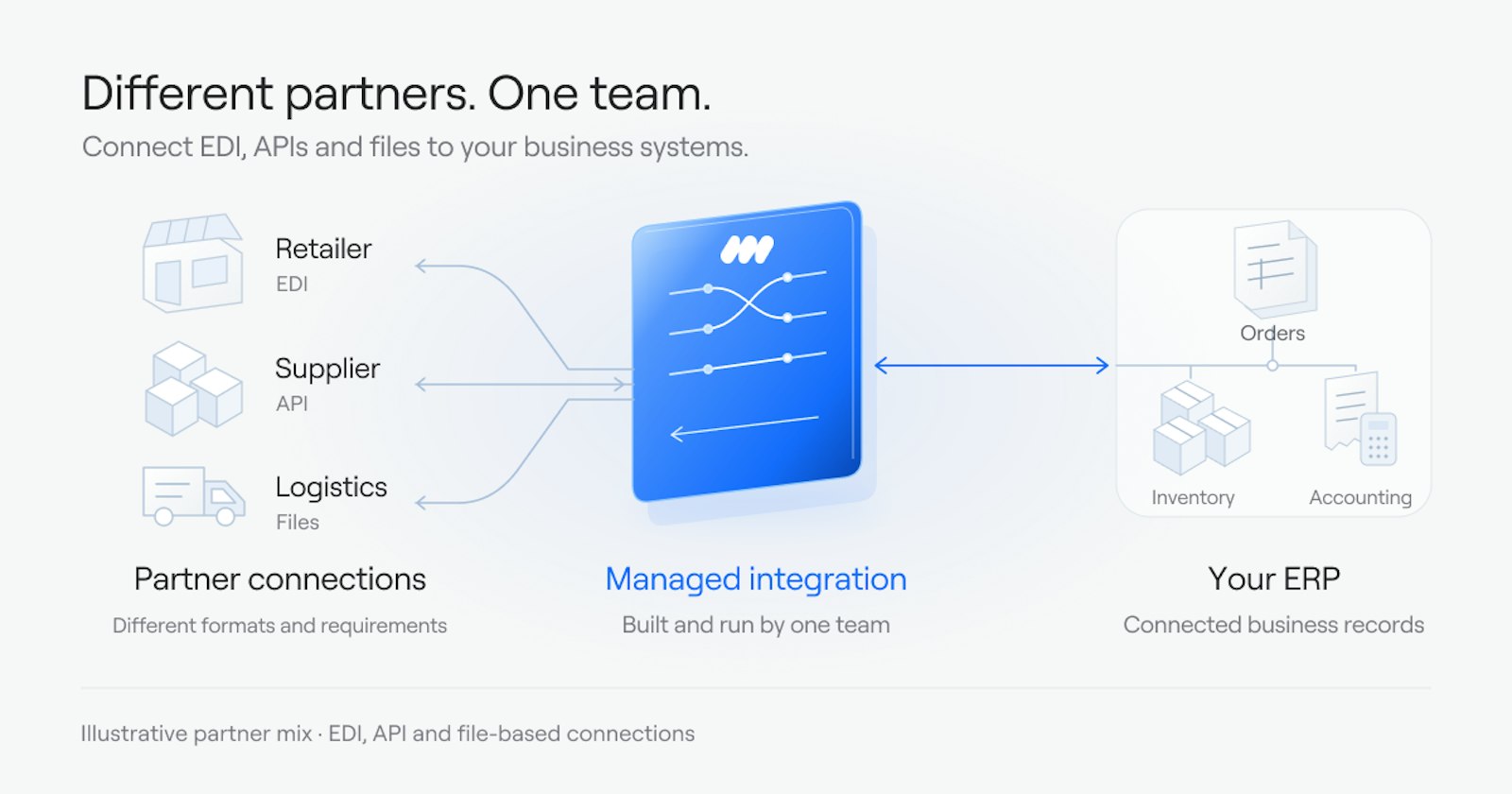
A company often needs more than one kind. A retailer may require EDI, a supplier may offer an API, and a logistics partner may work from files. A B2B integration service handles that mix through one team, rather than a separate project for each partner.
What a service usually includes
A full B2B integration service usually covers:
Scoping. Working out which partners, document types, and systems are in scope, and what each partner requires.
Building. Building the connections and mapping the data between systems, so fields line up and codes match.
Testing. Testing each connection with the partner before it goes live, including error cases, not only the happy path.
Running. Monitoring the connections after launch, catching failed transfers, and fixing them, so a failed order or invoice is not discovered days later.
Changes. Updating connections when a partner changes its requirements or a system changes, so the connection keeps working.
The running part is easy to underestimate. Connections break when partners change formats, systems are updated, or data changes shape. A service that only builds and hands over leaves that ongoing work with the company.
When a service is the right fit
A B2B integration service is worth considering when:
Partners require EDI or specific formats, and meeting those requirements takes specialist work.
The company has many partners, each with different requirements, and onboarding each one takes too long in-house.
There is no in-house team to build and maintain integrations, or that team is busy with other work.
Failed transfers have a real cost, for example a missed order, a late shipment, or a delayed invoice.
If a company has one simple connection and an in-house team with time to maintain it, building it in-house may be enough. The service case gets stronger as partner count, format differences, and the cost of failure grow.
What we do here
We build integrations and run them. That is the full-service side: we scope the work with you and your partners, build the connections, test them, and monitor them after launch. You describe the outcome you want, for example "when a partner sends an order, it should reach our ERP (Enterprise Resource Planning system) without anyone retyping it," and we build it.
For teams that want to build connections themselves, Cirra lets you describe the work in plain language, and it builds the workflow from your connected apps. Cirra connects to 3,400+ apps through one connection layer.
Where to start
If you are not sure which partner connections to build first, or where manual work and failed transfers are piling up, the Integration Health Check looks at your systems and shows where the manual work sits.