

What does live data mean in a business report?
A connected report can still contain different reporting periods and refresh times. Know what current means before making the decision.
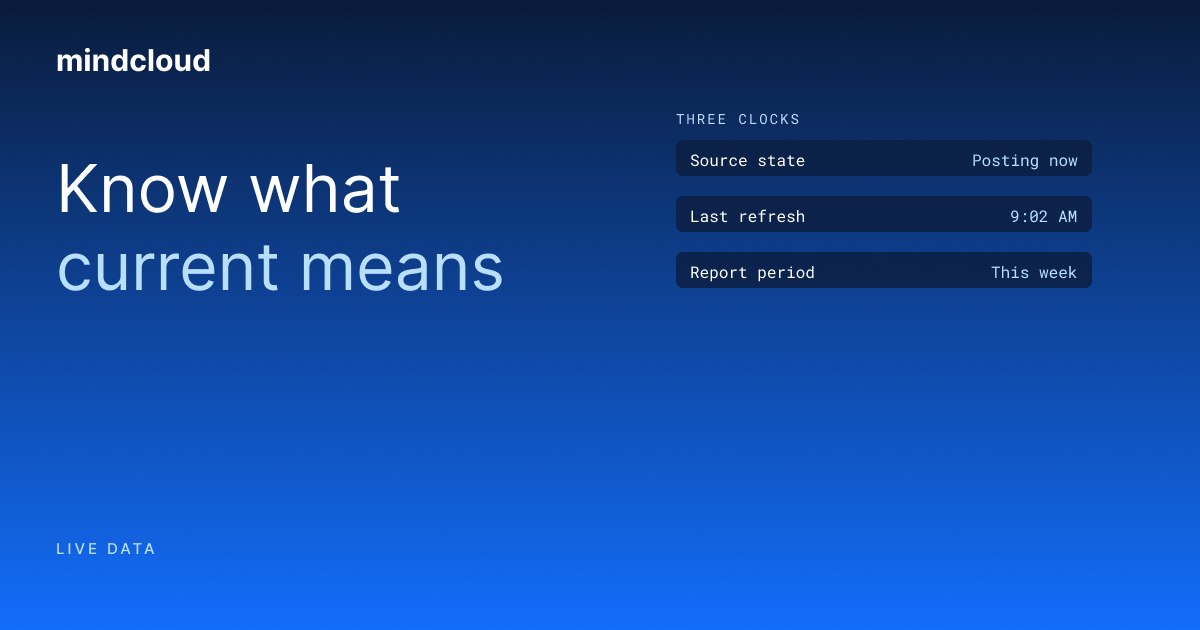
Live data in a business report means the report draws from connected sources rather than remaining a fixed copy of an earlier export. It does not, by itself, tell you how recently each source refreshed or whether the underlying business activity is complete.
Your useful question is what current means for the decision in front of you. A report for a completed month and a view of today's activity can both be connected to live sources while answering different questions.
A snapshot and a connected report serve different jobs
A snapshot preserves what was available at a particular point. That can be useful for a reviewed pack, an approved period or a record of what a meeting used.
A connected report can update as its sources refresh. That is useful when people need a current view without repeating the export and preparation work.
Neither format makes the definition of the number correct automatically. A copied spreadsheet and a connected page can both mix dates, include the wrong statuses or omit a source. The reporting rule still needs an owner.
Think through the clocks in the process
An illustrative sales report combines store activity with accounting information. A store order can appear before accounting has posted the related transaction. Both systems may be behaving correctly while showing different stages of the same business process.
There is also the time when the report last fetched each source. Finally, there is the reporting period selected on the page. Those boundaries can differ even when the charts appear next to one another.
That is why a useful review checks the source's state, the refresh schedule and the period being reported. Calling the page live does not collapse those into one moment.
Choose freshness for the decision
A team managing today's fulfillment may need recent order information. A finance team reviewing a closed period may care more about a stable, reconciled set of transactions.
Choose the update cadence around that need. Refreshing a source more often cannot force the source system to finish a posting process earlier. It can also make an unfinished period look more authoritative because the display updates frequently.
Write the expected timing in the report. Readers should not have to ask its creator whether a Monday morning total includes activity that is still arriving from the weekend.
Connected reporting still needs definitions
Decide which date controls each metric, how refunds and cancellations are treated and what currency or business unit the total represents. If two panels use different definitions, explain the difference or change the report.
When sources are combined, agree on how records match. A customer name appearing in several apps is not proof that all related records belong to one account. A current refresh can faithfully reproduce an incorrect join.
This is work to do while building the report, then revisit when the business changes. A new channel or accounting process can change what a familiar number means.
How Cirra Analytics fits
Cirra Analytics builds dashboards and written reports from descriptions or existing reports, using connected app data and uploaded spreadsheets. The data refreshes on a schedule, so each source in a report can sit at a different point when you read it.
The product can also deliver reports by email, Slack or Microsoft Teams. The delivery schedule and the source refresh are related settings, but they are not the same event. Plan the send around the state of the data you intend people to discuss.
For an executive audience, the result should be a report with fewer preparation steps and clearer definitions. It should not depend on a reader assuming that every number updates continuously.
Keep the limits visible
Analytics does not provide threshold alerts, row-level permissions or a data API, and external embedding is not publicly released. A source failure should be investigated rather than hidden behind the last available total.
It also does not correct the underlying accounting or operational record. If a source is wrong, the responsible team still needs to make the correction through the appropriate process.
If your team spends the meeting asking which version is current, bring us the report and the systems behind it. We'll start by defining the numbers and when they need to be ready.