MindCloud vs. DataBlend for Sage Intacct: who runs it after launch?
Compare MindCloud and DataBlend for Sage Intacct: implementation, ongoing support and who handles workflow changes after launch.
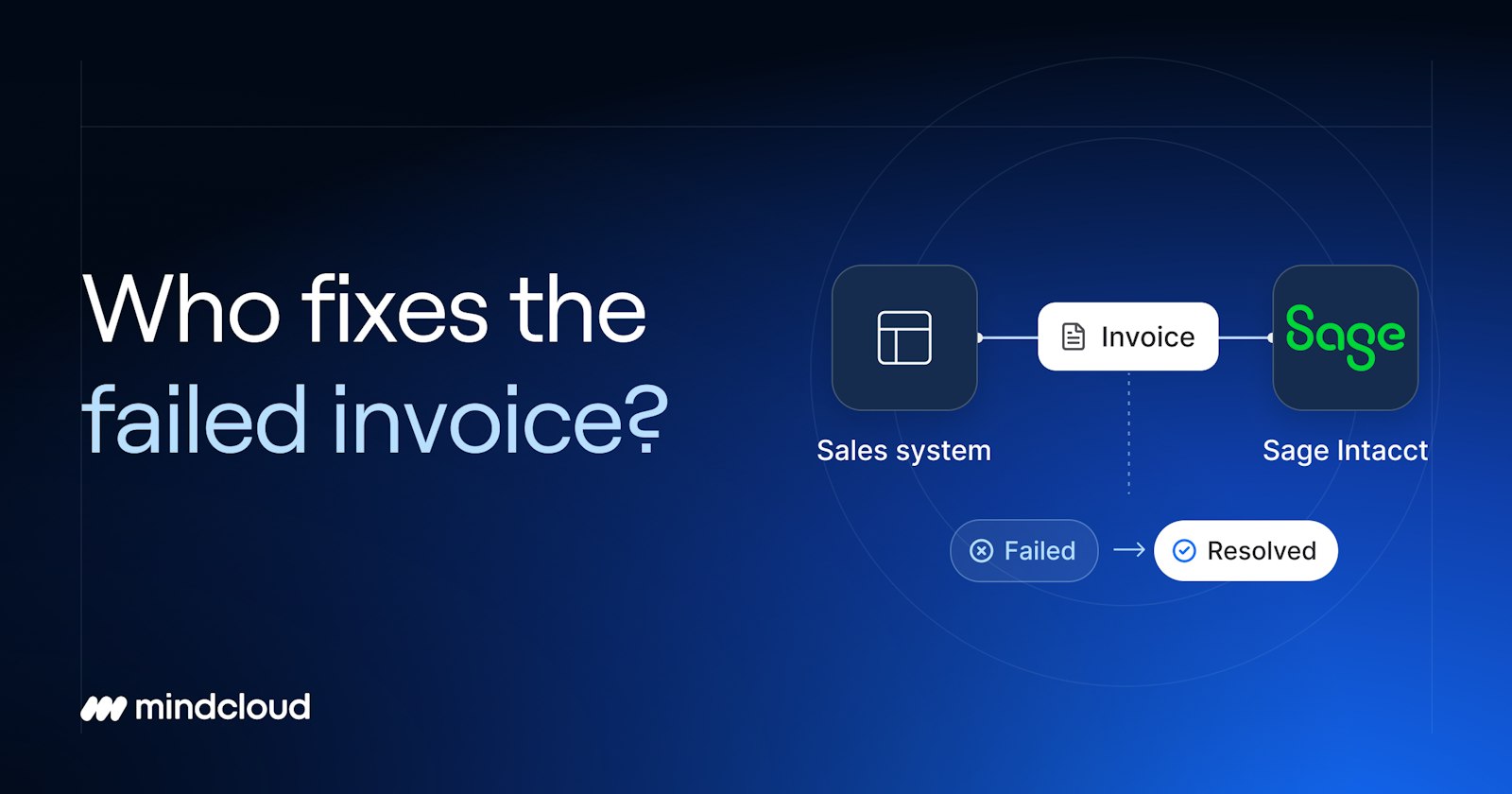
An invoice from your sales system fails to reach Sage Intacct, and your finance team needs it posted before close. Someone has to investigate, fix the problem and check that the next invoice goes through. Who that someone is should decide how you compare integration proposals for Sage Intacct, including MindCloud's and DataBlend's.
Both companies connect Sage Intacct to the other applications a business runs. DataBlend provides integration software, implementation options and technical support. MindCloud Full Service puts our own platform together with an in-house team that builds your integrations and then keeps them running. The proposals start to differ once you look past the first build at everything that comes after it, so that is where this guide spends most of its time.
MindCloud and DataBlend at a glance
Five things to put side by side when you read the two proposals.
Implementation
MindCloud Full Service: our in-house team scopes, builds, launches and supports each integration on our own platform, and nothing is handed off to a third party.
DataBlend: its published terms provide for implementation by DataBlend or by a reseller, under an agreed scope.
Ongoing support
MindCloud Full Service: dedicated support and a technical service-level agreement are included in the subscription.
DataBlend: standard technical support, as defined in its published service terms.
Monitoring and maintenance
MindCloud Full Service: monitoring, retry logic and proactive alerting on every production flow, with a 10-person operations team keeping your integrations running.
DataBlend: confirm in your agreement who monitors your workflows and who owns resolving an incident.
Workflow changes
MindCloud Full Service: three hours of professional services are included each month.
DataBlend: confirm which changes are included and which need additional consulting.
Subscription
MindCloud Full Service: one annual subscription, scoped to your requirements, covering the platform, the team that builds your integrations and the team that runs them.
DataBlend: its pricing page lists annual plans with application and workflow allowances, and packaging varies by plan.
We checked DataBlend's public pages on October 29, 2026: its service terms, pricing, integration FAQ and Sage Intacct Data Flows page. The MindCloud details come from our Full Service page. Published terms change, and your own proposal and service agreement are what count, so check the details for your project there.
What DataBlend offers
DataBlend focuses on connecting finance and accounting systems to the other applications a business uses. Its published terms provide for implementation by DataBlend itself or through a reseller, and its integration FAQ describes DataBlend handling discovery and setup for standard systems it has worked with before. Its Sage Intacct Data Flows page describes both prebuilt and customized integrations built on DataBlend.
If you are evaluating DataBlend, establish which route your quote covers, because a prebuilt Data Flow, a customized project and a reseller-delivered implementation may each have a different scope. Ask who handles the build, what happens after launch and how you request changes. Technical support, implementation and the day-to-day running of your workflows are separate responsibilities, and it is worth having each one written down.
What MindCloud Full Service includes for Sage Intacct
MindCloud is listed on the Sage Intacct Marketplace as the MindCloud Sage Intacct Universal Connector. Two kinds of workflow cover most of what finance teams ask us for, as described on our Sage Intacct integrations page:
Invoices from orders: MindCloud creates invoices and sales invoices in Sage Intacct from orders in your other connected systems, mapping the customer, amounts, line items and posting date.
Ecommerce sync: MindCloud creates and updates items and sales-order transactions in Sage Intacct, so it stays in sync with your ecommerce platform.
During scoping, agree which of these workflows your subscription covers and when a larger change needs its own scope.
Look beyond the first successful transfer
A workflow can pass its launch tests and still need attention later, because the systems around it keep changing. An application may change its connection requirements, your finance team may add a dimension or change how invoices are approved, and a new business unit may need a different mapping.
Take a sales system sending invoices into Sage Intacct. If Sage Intacct rejects an invoice because a required field is missing, someone has to investigate, correct the issue and confirm the invoice reaches the right place without creating a duplicate. Use that scenario when you review either proposal:
Who receives the failure notification?
Who investigates and corrects the issue?
Who checks whether affected records need to be processed again?
Who confirms that the workflow is running correctly?
Which of that work is included in the subscription?
A clear answer names the responsible team and the service that covers it.
Compare the ongoing commitment
Both providers sell annual subscriptions, so compare what you receive across the whole year rather than at launch. Put these items next to each other in the proposals:
The workflows and applications covered.
Implementation, testing and launch responsibilities.
Monitoring, troubleshooting and maintenance.
Included time for changes, and the process for additional work.
Required software access or third-party subscriptions.
Renewal terms, and the work your own team will keep.
Keep unknown items visible until they are answered, because an unlisted service is something to clarify with the provider, not something to assume. It also makes the second-year conversation easier: you can see which responsibilities continue after implementation and decide whether the ongoing service matches what your team needs.
Which approach fits your team?
If you are considering DataBlend through Sage Intacct Data Flows or a reseller, evaluate the complete package and establish who owns each part of the integration after launch. If you want one in-house team to build your workflows and keep them running, MindCloud Full Service is worth a conversation, and its included support, SLA and monthly professional-services hours give you a concrete scope to discuss.
Either way, bring the same workflow requirements to both conversations and ask each provider how it would handle the build, a failed run and a later process change.